Halifax Market Intelligence | May 2026
Source: Halifax Regional Municipality — UDI Breakfast Briefing, May 14, 2026 (Brad Anguish, Acting CAO)
Halifax's Growth Pipeline Reaches Historic Scale: What HRM's May 2026 Briefing Means for Property Owners
14,750 units under construction. Roughly 100,000 more proposed across 18 future communities. Nearly $900 million in transportation investment underway. Here is what the numbers actually mean for Halifax sellers, buyers, and long-term holders.
Executive Summary
|
14,750 Units under construction across HRM |
~100K Units proposed across 18 future serviced communities |
$866M+ Transportation investment committed for 2026–27 |
On May 14, 2026, HRM's Acting Chief Administrative Officer Brad Anguish delivered the municipality's spring growth briefing to the Urban Development Institute. The presentation was a quiet one. There were no headlines, no political theatre — just a series of numbers that, taken together, reframe what the next decade of the Halifax property market is likely to look like.
For property owners — particularly those holding established assets in the urban core, Bedford, or the mature suburban belt — the signals are worth reading carefully. The supply pipeline is no longer theoretical. The infrastructure investments that will reshape neighbourhood premiums are funded and moving. And the regulatory machinery that historically slowed delivery is, by HRM's own data, running materially faster.
The Supply Story Halifax Property Owners Should Understand
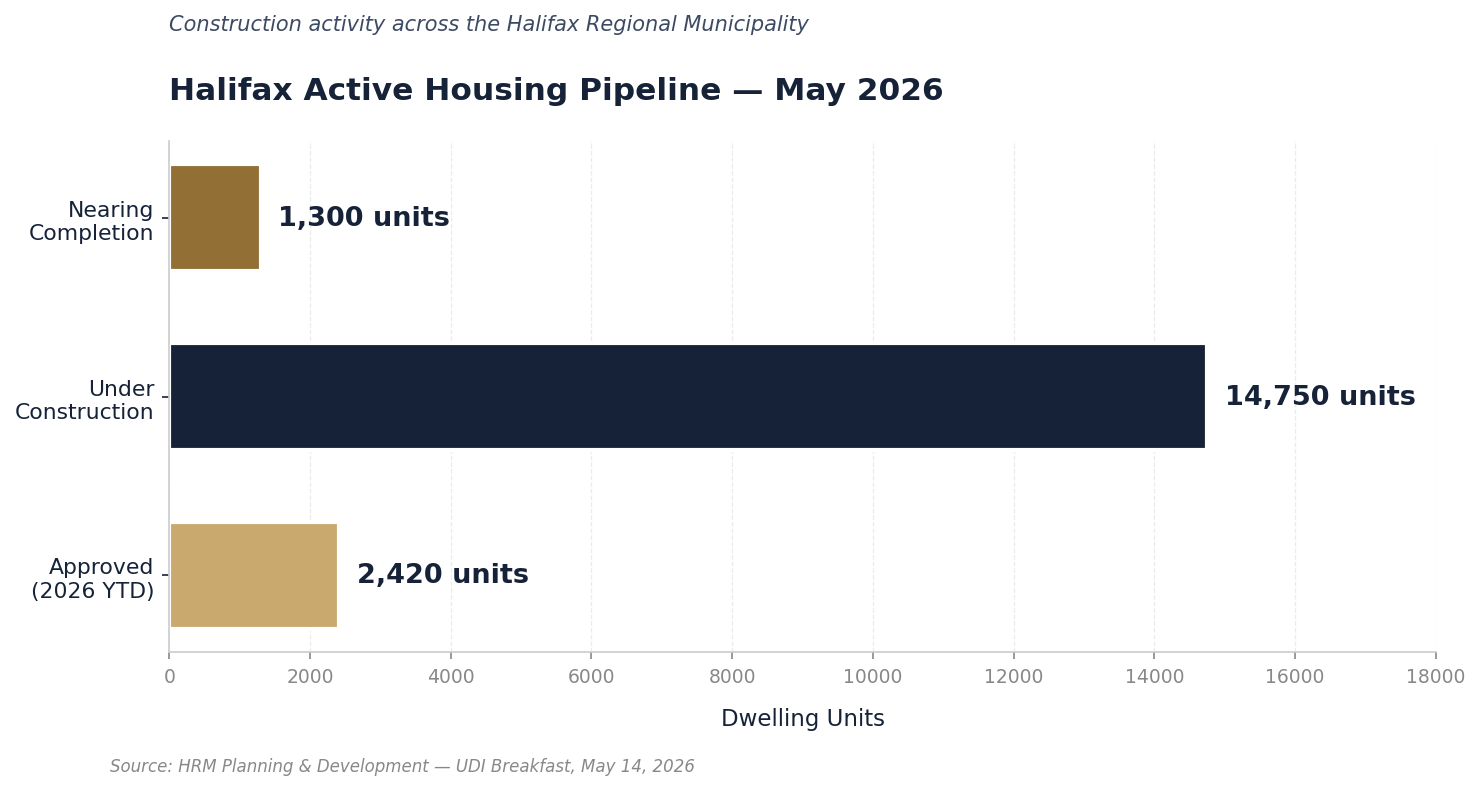
14,750 dwelling units are currently under construction across HRM, with 1,300 of those nearing completion. A further 2,420 new units have been approved in 2026 year-to-date — roughly 35 percent of the entire 2025 annual approval total reached before the end of May.
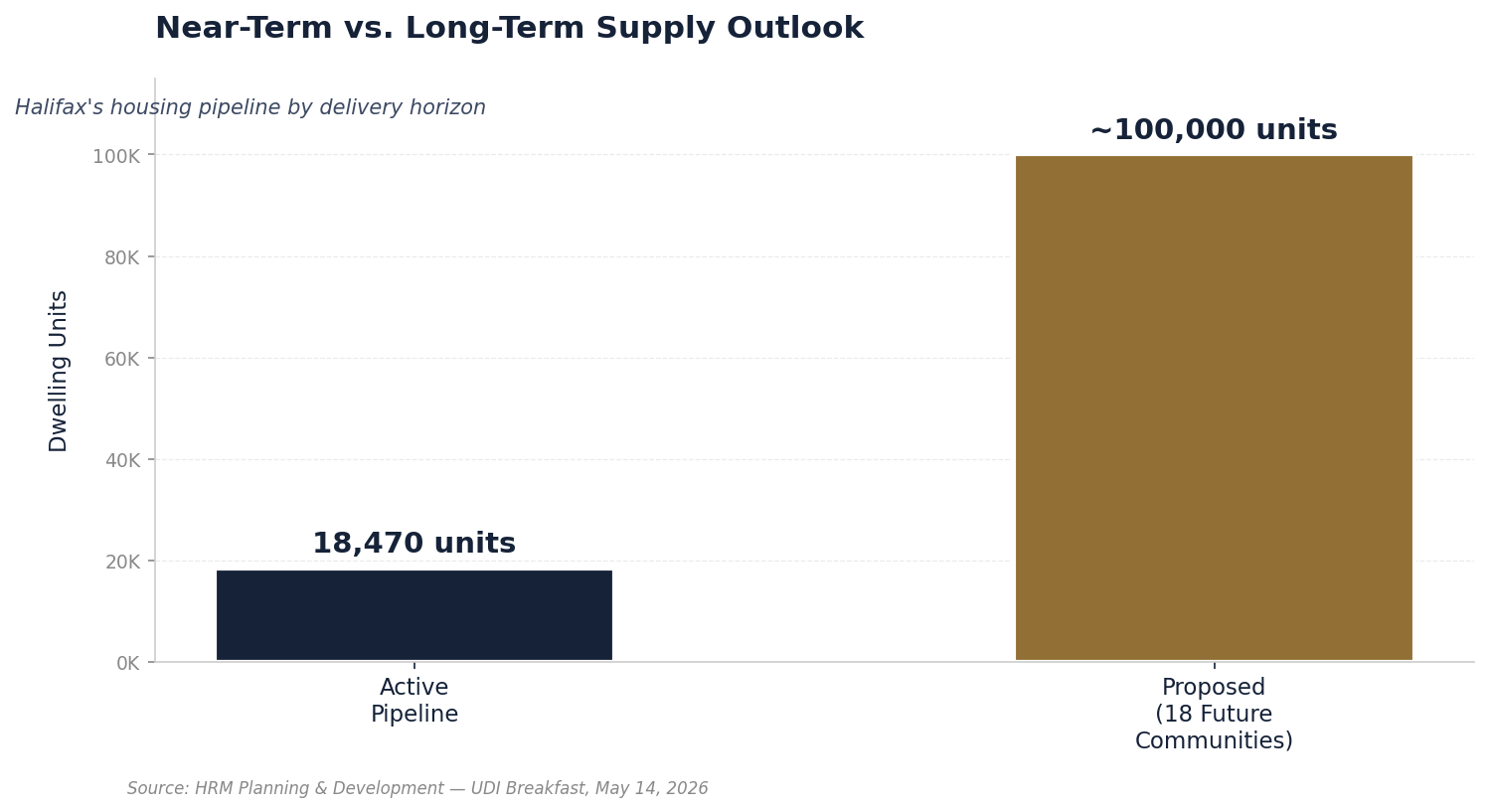
Layered on top of this active pipeline is something larger. HRM has identified 18 future serviced communities — including Sandy Lake, the Highway 102 corridor, Mill Cove, the Cogswell lands, Dartmouth Crossing, the Halifax Shopping Centre superblock, Bedford Commons, Paper Mill Lake, and the M-District growth node — that collectively could accommodate approximately 100,000 additional units over the planning horizon.
These are not abstract policy ambitions. The M-District alone — recently approved as a Future Growth Node — supports 4,600 units. The Regency Park Extension and Washmill development agreement adds another 3,830 units. Heritage development agreements approved in 2025–26 added 585 units in the urban core.
Key Takeaway
The next five years will bring more new housing stock to Halifax than the previous decade combined. The market is not oversupplied today — but the resale story for properties competing with new construction is going to require sharper positioning than it has in some time.
Where the Growth Will Concentrate
HRM's planned growth is not evenly distributed. It is intentionally concentrated along transit corridors, in underused commercial sites being repositioned for mixed-use density, and in the new serviced suburban communities at the edges of the existing footprint.
Urban core densification nodes:
- Cogswell lands — redevelopment nearing final completion, unlocking the long-isolated north entrance to downtown
- Young Street Superblock, Kempt Road, Joseph Howe, and the West End Mall site
- Halifax Shopping Centre and Exhibition Park redevelopments
- Heritage Development Agreements continuing to add density in the South End and peninsula
Bedford and the inner suburbs:
- Bedford Commons and Paper Mill Lake
- Mill Cove — anchored by a proposed $260 million ferry terminal project
- Strawberry Hill
Dartmouth and the eastern shore:
- Dartmouth Cove and Dartmouth Crossing
- Morris Lake and Westphal
- The M-District growth node (4,600 units)
New serviced communities at the edge: Sandy Lake and the Highway 102 corridor lands have both been advanced to secondary planning — meaning the regulatory groundwork is being laid for what may be the largest new master-planned communities Halifax has approved in a generation.
Infrastructure That Will Reshape Neighbourhood Premiums
Halifax property values have always been a function of location, condition, and access. The third factor — access — is about to change materially. HRM's 2026–27 transportation priorities include several investments large enough to recalibrate which neighbourhoods carry which premiums.
| Project | Investment | Market Implication |
|---|---|---|
| Windsor Street Exchange Rebuild | $180M | Direct effect on North End access and the Young Street superblock |
| Burnside Transit Centre | ~$400M | Anchors expanded transit on the Dartmouth side |
| Mill Cove Ferry Service | $260M | Brings Bedford-side properties into a competitive commute window |
| Bayers Road Multi-Modal Corridor | $22M | Reinforces the Clayton Park / Fairview commuter corridor |
| Cogswell Redevelopment | Final completion 2026 | Reconnects the downtown waterfront and unlocks adjacent values |
| BRT Network (Purple, Green, Red, Yellow Lines) | Multi-year capital plan | Stations from Lacewood to Portland Hills will establish new value corridors |
The Bus Rapid Transit network is worth particular attention. Once operational, BRT stations — from Lacewood through Mumford and Dalhousie to Portland Hills and Penhorn — will create the kind of fixed transit anchors that have historically driven sustained price growth in other Canadian markets. Properties within walking distance of confirmed BRT stations will not behave the same way they did pre-network.
Key Takeaway
The neighbourhoods that command the highest premiums in 2030 will not be the same set that command them today. Infrastructure decisions being made now will be priced into the market over the next 24 to 36 months.
Permit Acceleration: Supply Is Coming Faster
One of the more consequential numbers in HRM's briefing was administrative: average permit review times in 2026 year-to-date are 67 days for high-density and mixed-use permits and 18 days for low-density and missing-middle permits. Building inspections have already exceeded 11,500 in 2026 year-to-date, with more than 3,000 inspections in April alone — a record high.
The Housing Accelerator Fund — HRM's $79.3 million agreement with CMHC — is now 77.75 percent of the way to its 15,467-unit target, with 10 of 11 initiatives complete. The final initiative, an Affordable Housing Strategy, is targeted for August 2026 with council consideration before October.
What this means in practical terms: the projects already approved and under construction will deliver. The bottleneck of past cycles — the unpredictable, multi-year approvals slog — has measurably loosened. For sellers, that translates to genuine new competition arriving in the resale window, not vapourware.
What This Means for Halifax Sellers
Halifax is not facing a supply crisis in the resale market today. Inventory remains tight by historical standards, and well-priced properties continue to transact in reasonable timeframes. The point is forward-looking: the competitive landscape three to five years from now will look quite different.
For owners of established Halifax-area homes, three implications stand out:
- Pricing precision matters more than market timing. When new inventory enters the market in volume, the homes that move are the ones priced accurately to comparables and condition — not the ones positioned above the market in hope of a stretch buyer. This has always been true. It will be more true.
- Location strategy is being redrawn in real time. Properties on or near confirmed BRT corridors, ferry service expansions, and growth nodes have a structural tailwind. Properties far from these investments do not necessarily lose value — but the premium math is shifting.
- Condition and presentation will matter more, not less. When the resale buyer has new-construction alternatives at a similar price point, the resale home needs to make its case clearly. Move-in ready properties with thoughtful staging and accurate disclosure will continue to outperform.
What This Means for Buyers and Long-Term Holders
For buyers — and particularly for buyers thinking about a property as a multi-year hold — HRM's planning data is a roadmap. The neighbourhoods being prepared for serviced growth, the corridors receiving transit investment, and the underused sites being redeveloped will define the next cycle of Halifax value creation.
Long-term holders of well-located properties in established neighbourhoods are not in the path of disruption. Halifax's growth is largely additive — new units in new places — rather than substitutive. The supply story is real, but it does not erase the structural scarcity of well-located, well-maintained homes in mature areas.
For investors evaluating multi-family or land-banking opportunities, the message is more nuanced. HRM's own commissioned Inclusionary Zoning Market Analysis, completed in 2025, found that market conditions for high-density concrete and rental projects remain weak — impacted by high construction costs, elevated interest rates, and thin margins. The supply pipeline is large, but the financial feasibility of marginal projects is genuinely under pressure. That matters for absorption.
"The market that emerges from this growth cycle will reward owners who understand the data, position with precision, and stop trying to time a moment that has already moved on."
— Sandra Pike
Frequently Asked Questions
How many new housing units are coming to Halifax?
As of May 2026, HRM reports 14,750 dwelling units under construction across the municipality, with approximately 1,300 nearing completion. An additional 2,420 new units have been approved in 2026 to date. Across the 18 identified future serviced communities, roughly 100,000 additional units are proposed over the planning horizon.
Will all this new supply cause Halifax home prices to fall?
A meaningful supply increase is coming, but Halifax also has population growth objectives extending toward a municipality of up to one million residents under the Strategic Growth & Infrastructure Priorities Plan. The likely outcome is a more balanced market with sharper differentiation between well-positioned properties and those that are not — rather than broad price declines.
Which Halifax neighbourhoods will benefit most from BRT?
The proposed BRT network includes Purple, Green, Red, and Yellow Lines with stations from Lacewood through Mumford and Dalhousie to Portland Hills and Penhorn. Properties within walking distance of confirmed stations along these corridors are the most likely to capture sustained value uplift as the network is built out.
How long is it taking HRM to issue permits in 2026?
HRM reports average permit review times in 2026 year-to-date of 67 days for high-density and mixed-use permits, and 18 days for low-density and missing-middle permits — a material improvement on prior years.
What is the M-District?
The M-District is a Future Growth Node recently approved by HRM that supports approximately 4,600 units of new housing on the Dartmouth side. It is one of the larger single approvals in HRM's current planning cycle.
Final Thoughts
The HRM May 2026 briefing is not the kind of document that generates headlines. It is the kind of document that, three years from now, people will look back at and recognize as the moment the next decade of the Halifax property market came into focus.
The supply is real. The infrastructure is funded. The approvals are moving. None of this is alarming — Halifax is a growing municipality and growth requires housing — but it does change the question every property owner should be asking. The question is no longer whether the market will absorb what is coming. The question is how individual properties will be positioned to compete within it.
For sellers, that begins with accurate pricing, honest condition assessment, and a clear-eyed view of where each specific property sits in the new competitive landscape. For buyers, it begins with reading the infrastructure map — and recognizing that some of the most consequential value-creation decisions in Halifax over the next decade have already been made on paper.
Considering your position in the Halifax market?
A confidential, data-driven property valuation grounded in current HRM market conditions.
Sandra Pike | 902-478-8711 | sandrapike.ca
Authored by Sandra Pike, REALTOR® | The Pike Group, Royal LePage Atlantic
One of Halifax's Top Resale Listing Agents Since 2016 | Data-Driven Market Insights and Real Estate Commentary
84 Chain Lake Drive Suite 300, Halifax, NS B3S 1A2 | Stats from HRM Planning & Development — UDI Breakfast, May 14, 2026